Every day after opening our eyes after waking up we will do programs that have been instilled by ourselves. The programs in question are habits that are consciously or unconsciously done, done repeatedly every day. This is done because there are many influencing factors ranging from physical needs or psychological needs, usually the habits carried out by humans are something that is implanted deep into the human being himself, deep into his subconscious so that subconsciously the habit will be done repeatedly. Habit is a translation of habit, habit itself in language means; a repetition, done unconsciously, obtained through frequent repetition.
Habits from the psychological side, are defined as ways of thinking, desires, and feelings that are obtained through repetition of mental experiences that have occurred1. the habits reviewed up to this sentence are habits carried out by individuals not in groups, because when the habit becomes a routine activity carried out by a group of several people then the habit will shift its substance to become a tradition, and when the tradition has an area as a place of sustainability it will be agreed upon as a culture in that area.
Almost all people have different habits but there is a small possibility that allows humans with other humans to have the same habits. This can happen when people have the same pleasures or the same job so that the routines they do every day are almost similar, forming the same habits.
As an artist, it is common to always do painting or other visual-related activities, immortalizing personal or visual experiences into a medium, whatever it may be. The simplest form of visual form may be each artist’s own interpretation of it, but in general, sketching is the most common medium used by an artist to place ideas that come to mind or visual experiences.
………………
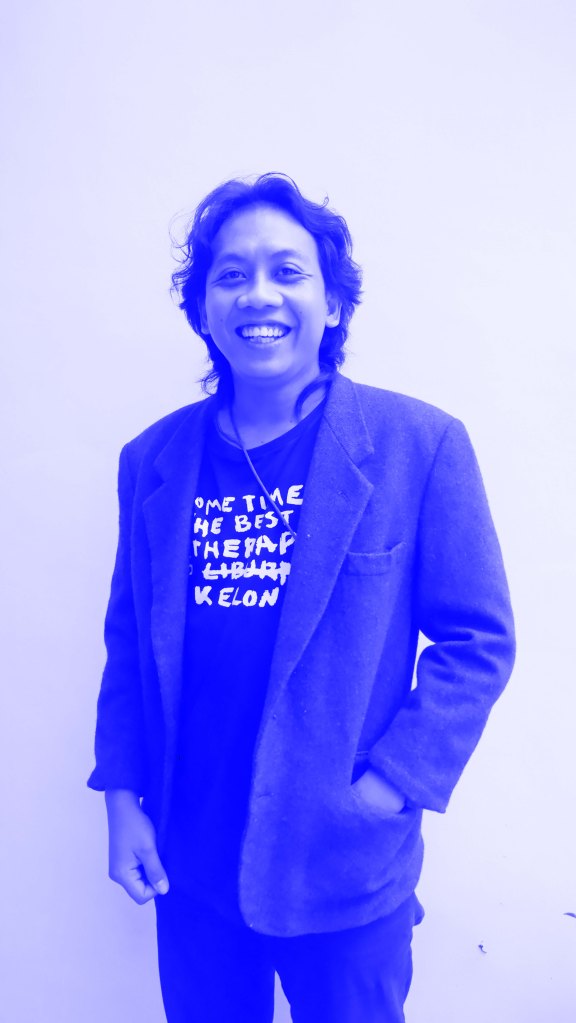
As humans with all the complexities instilled in us, we have to live with it and go through it day by day. As we go through the day, we as humans will have many collisions with our surroundings, with things that are personal or general. All people experience this with no exception, here Arif will tell a lot about personal problems into himself, problems about himself, imaginations that fly in his head, and the family that is always around him. Besides sketching as a habit, issues that revolve around himself-imagination-family are the outline of Arif’s works that are always inserted in each work he makes.
In addition to personal issues, Arif also wants to criticize other issues related to the media he uses in this exhibition, the media is paper, he feels that paper is an important component in the creation of great works, not just a trivial media that is considered less important, then discarded and less appreciated as a work where it should be.
In conveying his personal experience as a visual record or as sentimental forms when he creates works where Arif considers the process as worship, an obligation that must be done because he has been given by His grace and advantages, the process in which he works to create works has no time and place restrictions so he can make a work of art whenever and wherever he wants. Therefore, arif uses a medium that is considered flexible and practical but is able to contain ideas or visual records densely.
This exhibition will be filled with Arif’s works made from 2012 to the latest works made in 2015, at first the works made by Arif were not intended for solo exhibitions, but over time Arif was very aware of doing a form of documentation of his works, at that time he also felt it was important to convey his works into an open forum. In his solo exhibition held at his house in the afternoon, most of Arif’s works will be dominated by sketches, everyday works made by him. A work that emerges out of habit and awareness of the importance of documenting ideas or visual experiences into a medium, so that they do not just evaporate. Sketching is a common practice among artists, but what makes Arif’s works special are his distinctive figurative forms and expressionist strokes.
The artistic oeuvre presented herein focuses on the artist’s quotidian life. The visual compositions are characterized by a rigid and unyielding quality, employing bold and vibrant colors. Despite the expressionist nature of the visual images, they convey warm messages concerning daily life and the issues that Arif addresses.
Arif’s artistic oeuvre is classified as expressionist and is presented in the form of naive art. This approach aligns with the concept of gestural painting, which emphasizes the spontaneous and unique touch of the artist, their “handwriting,” and the emphatic texture of the paint.Notable artists associated with this style include Pollock, Willem de Kooning, and Franz Klik 2, each of whom exhibits a distinctive gesture in their works. Arif’s approach involves depicting his daily life and routine, incorporating events that might otherwise be overlooked. However, these seemingly mundane experiences are rendered interesting through his artistic lens. Arif’s artistic practice, in its documentation of quotidian life, resonates with Harold Rosenberg’s assertion regarding the essence of expressionism: “what was on canvas was not a picture but an event,” an event that revolves around the artist’s daily existence.
In Arif’s solo exhibition, the power that is raised is not only in the works but also in the arrangement of the works and the overall event.The arrangement of works in Arif’s solo exhibition will be arranged in such a way as to play the rhythm and fulfill the volume of works in the exhibition space. Prior to the implementation of this display method, Arif conducted experiments in his personal studio, with the objective of optimizing the display of works.
The personal satisfaction derived from the creation of a work is a sentiment shared by Arif, who also harbors a profound aspiration to pursue a career in the arts. The realization of a solo exhibition serves as a significant milestone in the pursuit of this ambition.
It is anticipated that this inaugural exhibition will serve as a catalyst, propelling Arif Mulyadi into the realm of the art world and potentially paving the way for subsequent solo exhibitions that may exhibit a more unconventional style.
1 American Journal of Psychology (1903)
2 Anason, H.H – Mansfield, C. Elizabeth. History of modern art (London,2012),435
- Written as a curatorial introduction to the HABI+ exhibition
- Solo exhibition by Arif mulyadi, he displays 200 works sketch which, sketches are works that depict everyday life.
- In 28 Mei 2015
- At Rumah sore art space Surabaya
- DOWNLOAD CATALOG
 Dwiki portfolio
Leave a comment