Artists are able to freely determine their aesthetic reference points. Sometimes an artist’s taste can be very strange and difficult for most people to accept by considering what is known as bad, scary, or beautiful as something beautiful and has a high aesthetic value in his eyes.
To establish an aesthetic point of reference in a person is a long process, a process that does not happen overnight, but starts from the person not having an understanding of aesthetics at all, to where he is now and what he has become. The process of forming an aesthetic point will never stop and will continue to move along with the experiences gained. The thing that affects the change in aesthetic value owned by a person is based on a person’s psychological experience which is much influenced by the surrounding environment, the treatment he gets, the pleasure or sadness he feels, and the interest in something. All will be calculated as a psychological experience which in the end the experience leads to a temporary point of beauty itself, a point of beauty that leads to its own sensation, whether it is happy, joyful, satisfied or so on.
Whether we realize it or not, media is the source of the experiences we get, which builds a lot of aesthetic conceptions. Then when we are able to describe and present how aesthetic we personally think, we will realize that we are in a cultural industry.
What is faced and calculated is part of a cultural industry that reflects the consolidation of commodity fetishism, domination, over exchange and the rise of state capitalism, the cultural industry shapes the tastes and inclinations of the masses, thus molding their consciousness by instilling their desires for false needs1. The cultural industry has an impact in a certain time that can be very long or very short, the cultural industry approach described by the Frankrut school is closely related to monopolistic practices carried out by a power that has power in a certain territory (the state) to make the people in it can still be controlled behavior through the doctrine of culture that is implanted. Apart from the state, the cultural industry is also carried out by a handful of minorities who have strong idealism towards a cultural flow as a resistance behavior to the growing popular culture.
When we do not have enough understanding to resist the discourse that is crammed either because such a culture has been accepted by cultural agents at an early age, it will be easy to be crammed with cultural doctrines which will be calculated when the agent is an adult, and the results will appear in any applied field where the agent is working. In a visual field of work, the experience that is a product of the dominant cultural industry that he received in the past will appear in the visual forms that he makes.
The integration of past and present, which is characteristic of experience, is manifested in the role played by the traditional storyteller, who is oriented towards practical interests. Thus, the stories told contain something useful for the reader.
the reader. At every turn, the storyteller is the one who conveys a message to the reader. The story should transmit experience in a way that unites the past and the present, the general and the specific2. Analogize the storyteller
Analogizing the storyteller as a painter and the reader as an appreciator of paintings, we will capture a similar pattern between various disciplines in art how he wants to raise a personal issue to be used as material that is interesting enough to attract the attention of art appreciators.
Aesthetics is the key word in this solo exhibition, a term that we often hear in every aspect of life, this term tends to be a visual term that refers to beauty. Aesthetics is an absorption word from the English language, namely aesthetic which comes from aisthanomai (Greek) which means things that are captured through the senses and lead to feelings, as opposed to things that are understood by reason. Munro also said that aesthetics is a way of responding to stimuli, mainly through sense perception, but also associated with psychological processes such as association, understanding, imagination, and emotion. Aesthetics is a science that studies everything related to beauty, studying all aspects of what we call beauty, aesthetics is something that studies the quality of beauty of objects, as well as the impulses and aesthetic experiences of creators and observers. Our response to this multifaceted visual world, both physiological and psychological – thus the whole background of our experience of visuals – is an important factor in our appreciation of abstract paintings.3 This statement seems to be an actual statement and can be applied in our understanding of works of art in this contemporary era not only for abstract works but all types of works.
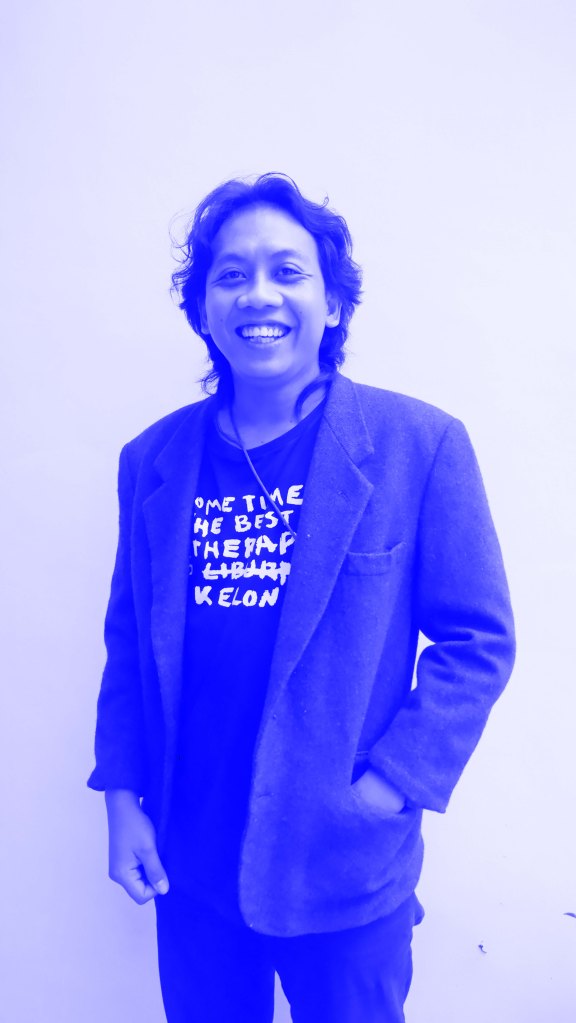
In this solo exhibition Prap will bring visitors to the exhibition into the storyline in the work that has been prepared for 1.5 years, the flow starts from the making of the work and the background of how the work is made, then the reason why using the selection of scary characters and dark colors in each work.
dark colors in each work displayed by Prap. However, with these scary characters and dark colors Prap is determined to say that it is beautiful, indeed there will be a gap in the meaning of beauty when what people see in general is a creepy thing.
but Prap believes it to be beautiful. This is the result of Prap’s aesthetic translation which is then transferred into a visual form, a beautiful form that however Prap herself needs legitimacy that she reached the point of visualizing a beautiful work according to her own version.
The personal experience of the artist to arrive at his current aesthetic reference point is a form of personal interest in metal music. And the illustrations depict metal music and sub-metal music, which raise issues of darkness, hatred, blood, and various things that have a connection with darkness. When Prap consumes a lot of such material then consciously or unconsciously the visual forms of Prap’s work will lead there. The classification of Prap’s works with illustration style, spooky and dark image characters leads to
Fantasy Art, where Fantasy Art has a definition as a genre that depicts non-realistic, mystical, mythical or folkloric subjects or events and styles, which are representational and naturalistic but not abstract. In France Fantasy Art is called lefantastique, in the UK it is sometimes called visionary art.
The form of Prap’s fantasy is not only played through canvas, but Prap also explores a lot using non-canvas media. The use of sound media will appear in several interactive works that have a strong attachment to metal music, with the work visitors will be brought into the situation of how Prap created the work.
brought into the situation of how Prap creates his work through audio guidance. Print illustrations will also be displayed in the exhibition space, Prap also explores applied chemistry where he will process a biological artifact to be displayed in this exhibition. In processing canvas-based works Prap also not only plays on the use of painting paint but to be able to bring out the essence of the work he made to the maximum he used his blood in the process of working.
There will be many interesting things in the works offered to the appreciators, Prap himself has great hopes that the appreciators who witness his work are able to get their own aesthetic experience with awareness without coercion, and can get the ‘beauty’ from their own point of view. The second hope is that the appreciators who see Prap’s work will be inspired and can do something in accordance with their respective fields.
Hopefully, this first solo exhibition is a good start to continue creating honest works that are able to represent Prap’s presence in the world of fine art in her current field and for long-term goals in the international realm as an ultimate achievement.
“Stand wherever you are when you understand the consequences, then keep running fast forward, don’t stop when others ask you to but stop when you feel it’s time.”
1 Strinati Dominic, Popular Culture (London,1995), 69
2 Soetomo Greg, Krisis Seni Krisis Kesadaran (Yogyakarta,2003), 85
3 Yuliman Sanento, Seni Lukis Indonesia Baru-Sebuah Pengantar (Jakarta,1976), 31
- Written as a curatorial introduction to the AESTHETIC exhibition
- Aesthetics | Pradika Lahitama Refananda solo exhibition
- In 6-11 December 2015
- At Gallery Raos Batu
 Dwiki portfolio
Leave a comment