What we wear is a reflection of ourselves there is a phrase that says so, but actually I don’t really agree with this expression because the surface never mentions it inside. When it comes to fashion, we will always think of a show that is grand, luxurious, and very exclusive, to the point that maybe we feel inappropriate to just attend it. In this paper I want to target the world of fashion done by the community to anticipate the development of fashion that passes so quickly but not everyone is able to keep up with the money they get, as a result duplication of goods appears as an alternative, many alternatives are offered as a tactic, ranging from alternative prices or from the economic sector, aesthetic alternatives, even alternatives that question the depth related to fashion and what we wear itself. Alternative forms from the economic point of view present duplication of goods with various qualities ranging from very similar quality resembling the original, there are also those made with mediocre quality and usually such goods have a very cheap price and are relatively affordable by every group.
This duplication of goods can be interpreted variously, I myself think of this pattern as an attempt at vandalism1 against a product that already has a large and widely recognized brand or maybe we call it a capitalist brand, I think this effort arises naturally thanks to how the mindset of the community is constructed here, education and communal knowledge are very influential things in its opening. Why don’t vandalists (people who hijack brands) create their own brand and sell it? It turns out that the problem of creating a brand and distributing it is much more complicated than just hijacking, creating, selling, and making a profit. The vandalist’s efforts can also be an alternative choice from an economic perspective.
Not so with artists, if these vandalists provide alternatives from an economic point of view, then artists will provide alternatives from an aesthetic and depth point of view, by making a work that is beautiful, horrifying, grotesque or disgusting artists try to present a new aesthetic exposure along with the depth of ideas that want to be discussed through their work. In this exhibition there will be 4 artists who are equally concerned with the world of fashion but they work in their own and different ways, such as Ojite who focuses more on the world of fine art but he also explores works using clothes as a medium, then Agus Sunandar is a graduate of UM and ITB fine arts but is now a fashion designer who has been poor across the national and international fashion world, then there is Agnes who experiments using plants in making her textile works, and there is Ican Harem an artist who is a very popular street fashion icon with works making drawings on denim and other media. These artists, who share the same concerns but approach their work in different ways, will collaborate to present an aesthetic and inward alternative to the public.
To what extent will the artists offer aesthetic and fashion-related insights? In this exhibition, the artists will present a variety of works, and several perspectives on the meaning of fashion will emerge.
……
For Agnes Christina, nature has been a source of inspiration for many works of art. After all, nature is life. Every organism is created with such uniqueness that they are all different from one another. If humans have thumbprints, then trees have leaf veins. No leaf is identical, even if it comes from the same tree branch.
LEAFTHIEF is the project exhibited in this event, Agnes’ project is to record the uniqueness of each leaf and make it usable as a textile. The works made in this project are done with monoprint technique using leaves and synthetic dyes. Furthermore, this project is an experiment by Agnes Christina in an effort to understand the human body, its characteristics and uniqueness. So the Fashion work that Agnes will present is a work about her process of studying humans but using another medium that can be an analogy.
……
Phrau Runako is the theme and label of Agus Sunandar’s Deluxe Ready to Wear. Agus Sunandar himself is a fashion designer who has been in the national and international fashion world. The visual ideas in the works created by Agus are basic designs with an emphasis on the use of contour lines on strong and firm silhouettes, as well as the use of bolt color dominance in gray, black, red and other strong colors. Many of them use Linen with a strong woven texture, all to represent the values of the life of today’s society which is full of enthusiasm, optimism, strength and openness.
In this exhibition Agus will showcase his collection which takes the theme “Phrau”, Phrau is a boat. A tool used as a source of livelihood for people on the coast. Boats and the lives of fishermen are interesting and inspiring for this collection. Agus’ background who was born in the coastal area on Madura island, an area that is hot, harsh but has a strong culture and a very open coastal community, makes Agus emotionally close to the theme. The emotional factor and the process that Agus has gone through while working become a knot and produce fashion works that are beautiful but have a deep meaning.
……
Ojite Budi Sutarno has his own interpretation of fashion. Starting from the process of his work, Ojite feels that art is not tied to a medium, but can be very broad, and what we wear also becomes a work of art itself. I think this idea is similar to the idea of wanting to break away from high art forms, as done in the dada movement1, which has the spirit to bring art to its essence, not just something that is distant or high art. From this term, Ojite began to create works not only using canvas but also making works that respond to clothing and several other mediums such as writing and novels.
“When we explain things/reality to others, we unintentionally create a new reality in the form of an explanation, when I explain my work to others, I make the explanation part of the medium of my other work, so the costume that I wear. So this costume is part of the explanation and credo of the works that I make into interactive works (bringing the work closer to the appreciator). The composition is fluid, it can increase or decrease (when the body becomes an art medium) the meaning of the work. The form of art as a spectacle or a fluid exhibition space; it can be carried on the street (carnival), and the like can be an alternative offered.” Ojite.
Wayang is also something that inspires Ojite in her work, but even though it inspires Ojite does not want to immediately convert wayang to the work she makes, she prefers to interpret the wayang herself and bring it up in a different form, but still conveys the same spirit. In creating her works, Ojite gets ideas from a contemplative process, by absorbing things that are around her and then precipitating them and processing the visuals to be applied into a work of art. Ojite believes that concept is part of embracing, believing and practicing a philosophy…
……
Ican Harem makes works by responding to ready-made fashion products such as clothes, pants and so on. Ican responds to these fashion products as a strategy to fulfill his own needs. In responding to fashion products, Ican ignores the existing aesthetic standards, which are agreed upon by most. Ican tends to present fashion products that are very young, raw, and irresponsible. Fashion products that have been modified and fused with Ican’s aesthetic taste appear as his work.
“Because I actually want to use the products myself..I have a need for clothing that is not ordinary..if you buy new expensive..the easiest thing to make yourself” Ican Harem.
The distribution carried out by Ican is not entirely a strategy carried out to introduce his work to the wider community, Ican made a work by responding to fashion products to fulfill his own needs, but over time many people agreed and favored Ican’s work. The process that occurs is very natural and tends not to be tendentious. After walking with such a pattern of making works and distributing them through social media, the function of Ican’s work shifted as a business that he was engaged in, if at the beginning it was to fulfill his own needs, but now because of the public’s interest in his work, Ican distributes his work with a different purpose, namely trading.
……
Of all the artists involved, they have their own angle in talking about fashion, I think there is almost no common thread except that all artists use fashion products as their work. But this is what makes this exhibition interesting. The 4 artists involved are enough to fill the exhibition space with different aesthetic and inward offerings.
And, in the end, the works that appear in this exhibition will be an interesting paradox about efforts to present an approach to work that tends to be populist and not confusing, but still leaves room for appreciators to have other interpretations related to the aesthetics and inwardness of a work that confuses itself with fashion.
1 Vandalism is the act of damaging and destroying works of art and other valuables (natural beauty and so on)” or ”violent and vicious destruction and defacement.
2 Dadaism is a rebellious school among artists and writers. It had the spirit of rejecting the “art is something high, expensive, serious, complicated, and exclusive” frame of mind. They hated the “high art” frame of mind because such art belonged to the upper middle class with a pseudo-aesthetic.
- Written as a curatorial introduction to the exhibition entitled Mixalibre
- EXHIBITION TITTLE : TRA X FANCY – Mixalibre
- ARTIST : Agnes Christina, Agus Sunandar, Ojite Budi Sutarno, Ican Harem feat. Ardalano.
- EXHIBITION PERIODE : 13-15 July 2018
- LOCATION : Rumah Opa, Jl. Welirang No.41a, Oro-oro Dowo, Klojen, Kota Malang, Jawa Timur 65119
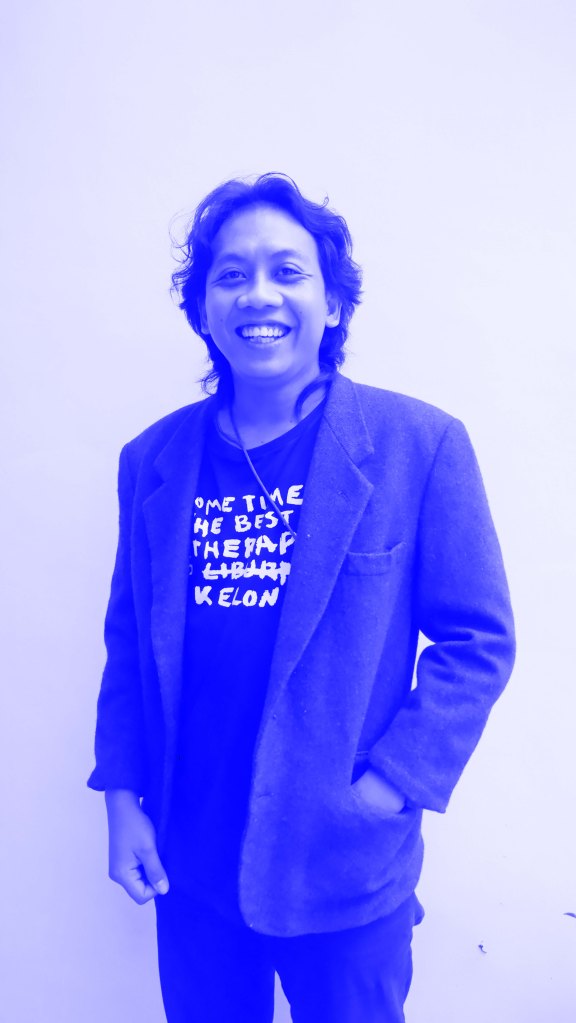
 Dwiki portfolio
Leave a comment